Treatment for Hair Loss in Women: What Options Are There? Noticing more hair than usual on the comb, in the shower, or on the pillow can be a cause for concern. Other times, the loss is not as noticeable, but gradually the bald spot becomes wider, the ponytail loses thickness, or certain areas of the …


Treatment for Hair Loss in Women: What Options Are There?
Noticing more hair than usual on the brush, in the shower, or on the pillow can be a cause for concern. In other cases, the shedding is not as obvious, but gradually the bald spot becomes wider, the coif loses thickness, or certain areas of the scalp start to become more visible.
Hair loss in women can occur for various reasons. Female androgenetic alopecia, certain hormonal changes, stress, postpartum, some nutritional deficiencies, or telogen effluvium are just some of the possible causes.
For this reason, seek a treatment for hair loss In women, it should not begin by directly choosing PRP, minoxidil, or any other therapy. The first step is to try to determine what is causing the hair loss and what characteristics it presents.
At Clínica Mandíbula de Diamante, with centers in Barcelona and Madrid, we address hair density loss through a medical evaluation and personalized programs that may incorporate different options such as hair PRP, minoxidil, mesotherapy, LED therapy, exosomes, and, only when there is a specific medical indication, other pharmacological treatments.
Why does hair fall out in women?
Losing a certain amount of hair is part of your natural cycle. The problem arises when the loss increases significantly, lasts for a long time, or begins to produce a noticeable decrease in density.
There is no single cause of hair loss in women. Therefore, two patients with seemingly similar symptoms may require completely different approaches.
Female androgenetic alopecia
Female androgenetic alopecia, also known as female-pattern hair loss, is one of the most common causes of progressive density loss.
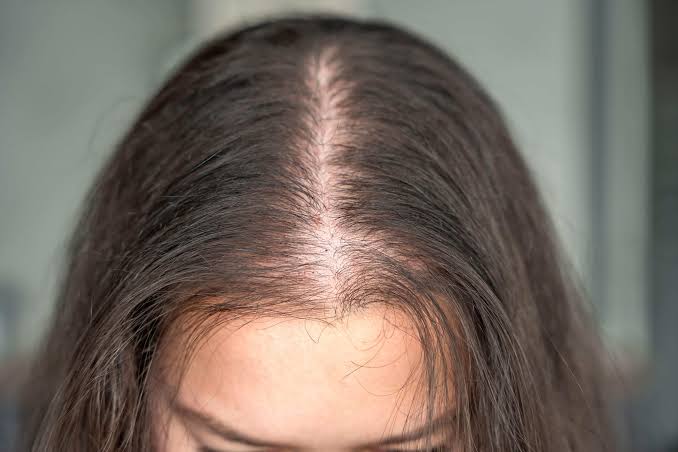
It can manifest itself through a gradual thinning of the hair and increased visibility of the scalp, especially in certain areas.
The evolution can be slow, which is why some women are not aware of the problem until the decrease in density becomes more noticeable.
Telogen effluvium
Telogen effluvium can produce a diffuse and more intense drop than usual.
In certain cases, it may appear after situations that affect the normal hair cycle, such as illness, surgery, important periods of stress, hormonal changes, or a significant weight loss.
Identifying the possible trigger is part of the medical evaluation.
Hormonal changes and menopause
Hormonal variations can influence the hair cycle and the characteristics of the hair.
During stages such as menopause, some women notice that their hair loses thickness, becomes thinner, or their density decreases.
However, not all hair loss during menopause has a single hormonal origin. It is important to study the pattern and rule out other factors.
Hair loss after pregnancy
After childbirth, a temporary increase in the fall may occur due to the changes experienced by the hair cycle.
In many cases there is a gradual recovery, but if the fall is very intense, prolonged or causes concern, a medical evaluation allows determining if there is any other factor that needs to be studied.
Nutritional deficiencies
Certain deficiencies can affect the health of the hair.
This does not mean that all women who experience hair loss automatically need vitamin supplements.
When there are indications of a possible deficit, the professional may consider it necessary to perform additional studies before establishing treatment.
Stress and other health factors
Intense stress, certain diseases, some medications, and various medical conditions can also be related to changes in the hair growth cycle.
Precisely because of the variety of possible causes, identifying the origin of the fall is one of the most important steps before starting a hair treatment.
When should I be concerned about hair loss?
It is not always easy to distinguish between a temporary fall and a problem that requires evaluation.
Special attention should be paid when signs such as:
- a fall clearly higher than the usual one;
- persistent loss for several weeks or months;
- the hairline progressively becomes wider;
- the hair becomes increasingly finer;
- visible decrease in density;
- areas of the scalp that were not previously visible;
- localized loss;
- changes in the skin of the scalp;
- itching, discomfort or inflammation associated with the fall.
It is also reasonable to request a evaluation simply when hair loss causes concern.
Waiting for the density to decrease very significantly is not always the best strategy.
Capillary diagnosis at the Diamond Mandible Clinic
In our clinic, we consider the capillary medical consultation to be the starting point of the treatment.
The goal is not to automatically recommend the same procedure to all patients; rather, it is to understand the characteristics of the fall before establishing a program.
During the consultation, aspects such as:
- pattern of hair loss;
- evolution of the drop;
- capillary density;
- characteristics of the scalp;
- family history;
- hormonal changes;
- pregnancy or postpartum;
- menopause;
- recent illnesses;
- medication;
- food;
- stress situations;
- Capillary treatments performed previously.
When the situation requires it, the doctor may assess the need for additional studies.
This approach allows for designing a treatment for hair loss in women tailored to each case, rather than selecting a therapy solely because it is popular.
Treatments for hair loss in women
Once the cause and characteristics of hair loss have been studied, different alternatives can be evaluated.
At Clínica Mandíbula de Diamante in Barcelona and Madrid, we have hair restoration programs that allow you to select different treatments and, when appropriate, combine them within a personalized strategy.
Minoxidil for hair loss in women
Minoxidil is one of the treatments used for certain types of hair loss, including female androgenetic alopecia.
Its goal is to promote the growth and maintenance of hair in appropriately selected patients.
However, there are several important aspects that must be taken into account.
The results do not appear immediately. The hair cycle takes time, so the evolution should be evaluated in the medium term and following the instructions of the professional.
Furthermore, not all patients need exactly the same protocol.
Consistency is also important, as the benefit obtained with minoxidil may depend on the continuity of the treatment.
In pregnant women, who are trying to become pregnant or during certain stages such as breastfeeding, the use of pharmacological treatments should be specifically evaluated by the doctor.
Therefore, we recommend avoiding self-medication and establishing a diagnosis first.
Capillary PRP in women
Capillary PRP or platelet-rich plasma is one of the regenerative medicine options that can be part of certain programs for the loss of capillary density.
The procedure begins with a blood draw from the patient herself. Subsequently, through a preparation process, a plasma fraction is obtained that contains a concentration of platelets and growth factors.
This plasma is applied to the scalp following the established protocol.
PRP can be used in certain patients as part of a strategy aimed at promoting follicle conditions and improving parameters related to the quality and density of the hair.
It should not, however, be presented as a solution capable of restoring any lost hair or as a universal cure for alopecia.
The indication, the number of sessions, and the possibility of combining it with other therapies depend on each patient.
Capillary mesotherapy for women
Capillary mesotherapy allows for localized treatments on the scalp using protocols selected according to the medical indication.
It can be integrated into a hair care program when the professional considers that it can contribute to a broader strategy.
There is no single mesotherapy that is appropriate for all forms of hair loss.
For this reason, at Clínica Mandíbula de Diamante we first assess the problem and then determine whether mesotherapy makes sense and which protocol may be appropriate.
LED therapy for hair
LED therapy can be used as a complementary treatment within certain capillary programs.
Its role within the protocol will depend on the diagnosis and the other therapies selected.
Instead of presenting it as a stand-alone solution for any type of alopecia, it can be integrated into a broader approach when there is an appropriate indication.
Exosomes within the capillary programs
Exosomes are part of regenerative treatments that have aroused interest in aesthetic and hair medicine.
At Mandíbula de Diamante Clinic, they can be evaluated as a complementary option within certain personalized programs.
It is especially important to maintain realistic expectations: they should not be considered a universal cure for alopecia or a guarantee of regeneration of all the lost follicles.
Its use must be based on medical criteria and the general context of each patient's treatment.
Can finasteride or dutasteride be used in women?
This is a particularly important issue when we talk about treatments for female alopecia.
Finasteride and dutasteride act on hormonal mechanisms related to certain types of hair loss. Although they may be considered by a doctor in select women, they are not suitable treatments for all patients.
Its use requires individualized medical evaluation and there are especially important restrictions related to pregnancy and the possibility of pregnancy.
For this reason, at Clínica Mandíbula de Diamante we do not recommend finasteride or dutasteride as a general solution for any woman who is experiencing hair loss.
The doctor must assess the diagnosis, the individual situation, the possible risks, and the alternatives before considering this type of treatment.
Which treatment for hair loss to choose?
Each option plays a different role within a hair care program:
| Treatment | Focus | Paper within the program |
| Minoxidil | Growth and maintenance in selected indications | Medical treatment |
| Capillary PRP | Growth factors | Regenerative/complementary |
| Mesotherapy | Localized treatment | Complementary |
| LED Therapy | Photobiomodulation | Complementary |
| Exosomes | Regenerative focus | Complementary |
| Finasteride/Dutasteride | Action on hormonal mechanisms | Only selected patients |
The choice should not be made solely based on the name of the treatment or because it has worked for someone else.
The diagnosis determines which options may make sense for each patient.
Is it better to combine several hair treatments?
In certain cases it may be appropriate to use more than one strategy.
Hair loss is a complex process and it may be necessary to act on different factors. For this reason, after the consultation, the doctor may propose a personalized hair treatment program.
Depending on the diagnosis, the combination of medical treatment with PRP or other complementary therapies can be studied.
In other cases, a simpler strategy may be sufficient.
The goal is not to perform as many procedures as possible, but to select only those that may be meaningful for the patient.
Treatment for hair loss after pregnancy
Hair loss after childbirth is a common concern.
Hormonal changes related to pregnancy can temporarily alter the normal hair cycle. As a result, months after giving birth there may be a more intense and diffuse hair loss.
In many women this situation improves progressively.
However, when the loss is very intense, persists longer than expected, or there are other symptoms, it is advisable to evaluate the case to check if there are additional factors.
During the postpartum period and especially during breastfeeding, the choice of any pharmacological treatment should be made with special caution and under medical supervision.
Hair loss during menopause
Many women begin to notice changes in their hair around the time of menopause.
The hair may become thinner and gradually lose density. Female-pattern alopecia that had previously gone unnoticed may also become more evident.
However, attributing any decline exclusively to menopause can lead to overlooking other causes.
A capillary assessment allows the pattern of hair loss to be analyzed and to decide whether there is a need for minoxidil, PRP, complementary treatments, or other options.
Treatment for hair loss according to age
Age provides information, but by itself it does not determine what treatment a woman needs.
Hair loss in young women
In young women, there can be very different causes: genetic factors, stress, certain deficiencies, changes in the hair growth cycle, or other situations.
Therefore, the diagnosis is particularly important before starting treatment.
Hair loss starting at age 40
Starting at this stage, some women begin to notice a gradual reduction in hair density or a thinning of the hair.
Hormonal changes can influence it, but they must be studied alongside other factors.
Hair loss starting at age 50
Menopause, hair aging, and the possible progression of female alopecia can coincide.
In these situations, it can be especially useful to design a customized program and monitor its progress.
Age does factor in, but it does not replace the diagnosis.
Treatment for hair loss in women in Barcelona and Madrid
At Clínica Mandíbula de Diamante we understand that behind the phrase “my hair falls out a lot” there may be very different situations.
That is why our goal is not to automatically recommend the same treatment to all women.
In our centers in Barcelona and Madrid, the process begins with a medical evaluation to study the type of hair loss and design a personalized strategy.
Our hair program may include, when indicated:
- medical consultation;
- PRP / Platelet-Rich Plasma;
- hair mesotherapy;
- minoxidil;
- LED therapy;
- exosomes;
- dutasteride in selected patients;
- finasteride in selected patients.
The possibility of having different alternatives allows the program to be adapted to the diagnosis and modified according to the evolution.
Why have your hair treatment at Clínica Mandíbula de Diamante?
In a problem like hair loss, having different treatments is important, but knowing when to use each one is even more important.
Therefore, our approach is based on several pillars.
Medical evaluation
Before recommending a procedure, we seek to understand the characteristics of hair loss and the possible associated factors.
Customized program
There is no single protocol for all women.
A patient with androgenetic alopecia may need a different approach than a woman who experiences temporary hair loss after a period of stress or after pregnancy.
Different treatment options
We have medical, regenerative, and complementary alternatives that can be selected individually.
Follow-up
Hair has its own cycle and changes take time.
Therefore, monitoring allows evaluating the evolution and adapting the program when necessary.
Clinics in Barcelona and Madrid
Mandíbula de Diamante Clinic has centers in Barcelona and Madrid, where we offer our programs aesthetic medicine and personalized hair treatments.
Frequently asked questions about hair loss in women
What is the best treatment for hair loss in women?
There is no single treatment that is suitable for everyone. The choice depends on the cause of hair loss. Minoxidil, PRP, mesotherapy, and other therapies may have different indications.
Why is my hair falling out so much?
The hair loss may be related to female androgenetic alopecia, telogen effluvium, hormonal changes, stress, postpartum, certain deficiencies, or other causes. If the hair loss is persistent or significant, it is advisable to undergo a evaluation.
How to stop hair loss in women?
The first step is to identify the type of fall. Once the diagnosis is established, a treatment can be designed that addresses the cause and characteristics of the problem.
Can lost hair grow back?
It depends on the type of alopecia, the condition of the follicles, and other factors. Some forms of hair loss can be reversible, while others require treatment and follow-up to try to maintain or improve the density.
Does PRP work for hair loss in women?
PRP can be used in selected patients as part of a hair restoration program. Response varies among individuals and should not be considered a guarantee of recovery of all lost hair.
How long does a hair treatment take to take effect?
Hair grows slowly and results should not be evaluated after a few days. The time required depends on the diagnosis and the treatment used.
Can minoxidil be used by women?
It can be used in certain women with specific types of hair loss. The indication should be evaluated, especially when there is pregnancy, planning of pregnancy, or breastfeeding.
Can finasteride or dutasteride be used in women?
In certain patients they may be considered by the doctor, but they present important limitations and are not indicated for all women. They require evaluation and medical supervision.
What treatment is used for hair loss during menopause?
It depends on the type of hair loss. Menopause can coincide with different hair problems, so the pattern must first be determined and then the treatment selected.
Where to treat hair loss in women in Barcelona or Madrid?
At Clínica Mandíbula de Diamante we have centers in Barcelona and Madrid and offer medical evaluation and personalized capillary programs with different therapeutic options.
Do you notice that you are losing hair density?
If your hair is getting thinner, your hairline has widened, or you notice that you’re losing more hair than usual, you don’t need to choose a treatment on your own.
The first step is to try to determine why the fall is occurring.
At Clínica Mandíbula de Diamante we perform a medical assessment and design personalized programs for hair loss in women in Barcelona and Madrid, selecting the treatment options based on the characteristics of each patient.
Book your hair consultation at Clínica Mandíbula de Diamante and discover which strategy may be best suited to your case.